Soil Science Ch 5. Soil Formations : Factors and Processes
5.1 Jenny's CLORPT Model (1941) — Foundation
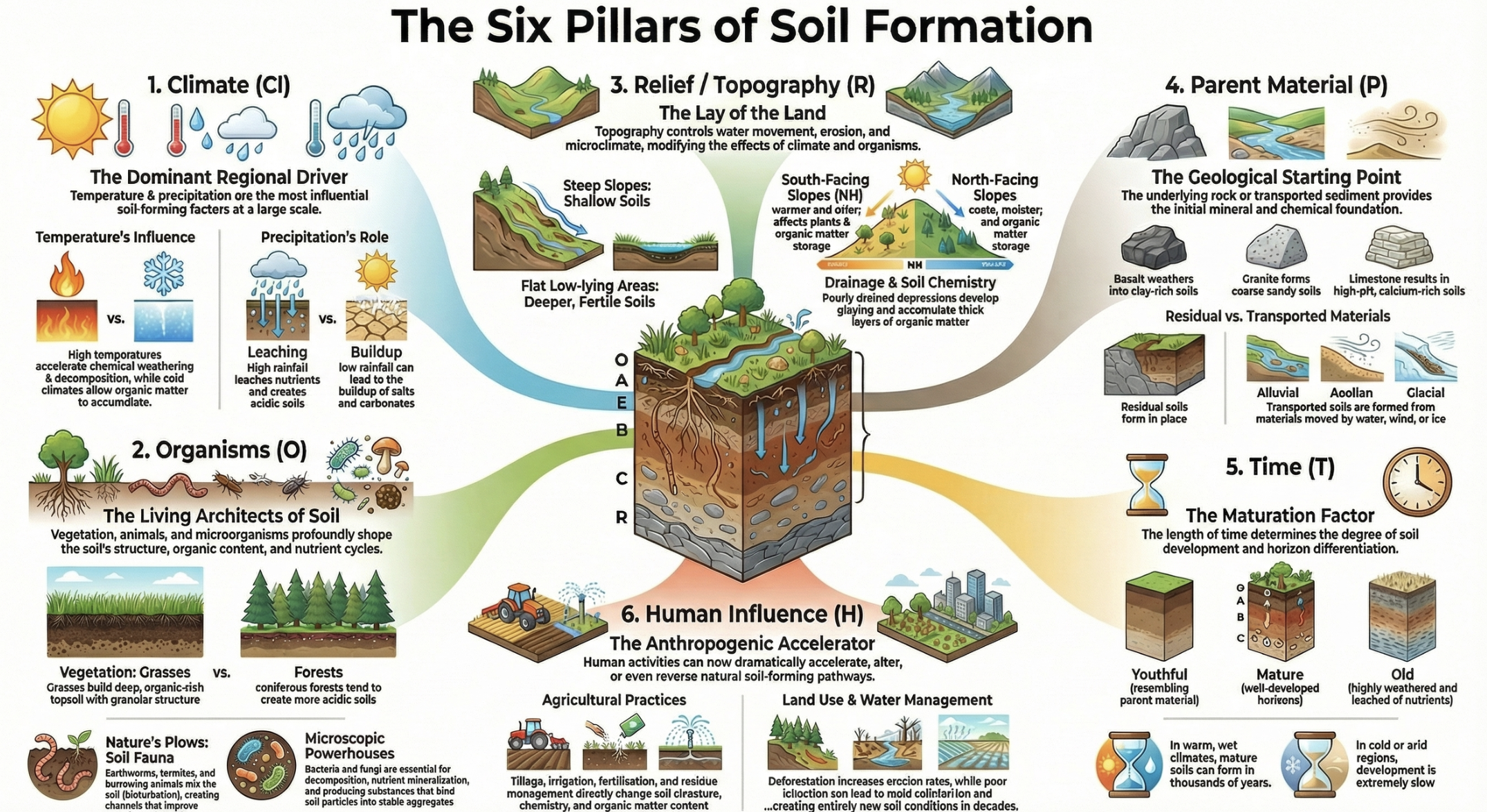
Hans Jenny's 1941 equation, S = f(Cl, O, R, P, T), forms the absolute foundation of pedology. It states that Soil (S) is a function of Climate (Cl), Organisms (O), Relief (R), Parent material (P), and Time (T).
The core principle of this model is that if you change any single factor while holding the others constant, a completely different soil will form. This provides the scientific basis for comparing soils across different landscapes. These factors are broadly classified into two categories:
- Passive Factors: These set the base conditions and include Climate, Parent Material, Topography (Relief), and Time.
- Active Factors: These are the agents that transform the passive materials, consisting of Organisms (with humans being the most dominant active factor today).
- Relative Importance: While highly context-dependent, the general hierarchy of influence is Climate > Organisms > Parent Material > Relief > Time.
5.2 Factor 1 — Parent Material
A. Definition and Types
Parent material is the mineral or organic substrate from which a soil forms; it is the starting composition for pedogenesis (soil formation).
- In-situ / Residual: Soil forms directly over the underlying bedrock. For example, granite produces a sandy soil, while basalt produces a clay-rich soil.
- Transported Types: * Alluvial: River-deposited material consisting of mixed sand, silt, and clay (e.g., the Indo-Gangetic Plains and coastal plains).
- Aeolian: Wind-deposited material, including sand dunes (like the Rajasthan Thar desert) and loess (fine silt blown from arid areas).
- Lacustrine: Lake-deposited material with fine silty textures, commonly found in old lake beds.
- Marine: Sea-deposited material that is often coastal, saline, and calcareous.
- Glacial (Till): Glacier-transported material containing a poorly sorted mix of boulders and clay, common in Himalayan valleys.
- Colluvial: Gravity-deposited material on slopes, such as talus or landslide debris accumulating at the foot of hills.
B. Parent Material of Major Indian Soils
- Basalt (Deccan Trap Lava): Rich in iron, magnesium, and calcium with high weatherability. It weathers into montmorillonite clay, forming the Vertisols (Black Cotton Soils) of Maharashtra, Madhya Pradesh, Gujarat, Karnataka, and Andhra Pradesh.
- Granite / Gneiss: Coarse-grained igneous and metamorphic rocks that weather into kaolinite clay and a sandy texture, forming the Red Soils of South India.
- Alluvium (River-Mixed): Highly variable in texture, this young and fertile material forms the Alluvial Soils of the Indo-Gangetic Plains, making them the most productive soils in India.
- Aeolian Sand (Quartz): Low in nutrients and highly sandy, forming the Desert Soils of Rajasthan, which are highly susceptible to wind erosion.
- Fe/Al-Rich Tropical Material: Highly pre-weathered material that forms the Laterite Soils of the Western Ghats, Meghalaya, and Odisha.
C. Effect of Parent Material on Soil Properties
- Texture: Coarse parent material (like granite or quartzite) yields a coarser soil, whereas fine parent material (like basalt or shale) yields a finer soil texture.
- Mineralogy: The parent rock determines the primary nutrient reserve. Feldspars release K⁺, Ca²⁺, and Na⁺, while mafic rocks like basalt release Fe²⁺, Mg²⁺, and Ca²⁺.
- pH: Limestone dictates a neutral to alkaline soil. Granite under high rainfall creates acidic soil, while basalt initially forms a neutral soil.
- Weathering Rate: Soft sedimentary rocks weather the fastest, igneous rocks weather at a medium rate, and hard metamorphic rocks like quartzite weather the slowest, ultimately dictating the speed of soil development.
5.3 Factor 2 — Climate (The Most Important Factor)
A. Temperature Effects
- High Temperature: According to the van't Hoff rule, the chemical weathering rate doubles for every 10°C increase in temperature. In the tropics, organic matter decomposes 3 to 5 times faster. This drives deep weathering, leading to laterite and oxisol formation in hot, humid climates.
- Low Temperature: Chemical weathering and organic matter decomposition slow down drastically, leading to organic accumulation (such as peat soils in cold climates). In regions like the Himalayas, soils remain shallow and immature despite high rainfall due to the freezing temperatures.
- Freeze-Thaw Cycles: Water expands by 9% when it freezes. When water enters rock crevices and freezes, it exerts massive pressure, cracking the rock in a process called frost weathering—a critical mechanism in Himalayan pedogenesis.
B. Precipitation Effects
- High Rainfall (>1500 mm/year): Causes intense leaching that strips the soil of calcium, magnesium, and potassium, leading to severe acidification. Silica is leached away, leaving a residual concentration of iron and aluminum, forming Laterites and Oxisols (e.g., Western Ghats, Northeast India).
- Moderate Rainfall (600–1500 mm/year): Results in balanced leaching, creating fertile, moderately acidic to neutral soils typical of alluvial plains and the black cotton soil regions of central India.
- Low Rainfall (<600 mm/year): Leaching is minimal, allowing salts, calcium carbonate (CaCO₃), and gypsum to accumulate. This forms the alkaline to strongly alkaline soils of Rajasthan, semi-arid Gujarat, and Haryana.
- P/E Ratio (Precipitation to Evapotranspiration): If the ratio is greater than 1, leaching dominates and acid soils form. If it is less than 1, accumulation dominates, leading to saline or alkaline soils.
5.4 Factor 3 — Organisms (Biota)
- Vegetation (Primary Biotic Influence): * Forests provide high litter input (5 to 15 t/ha/year) and form a thick organic A horizon, though organic acids lead to soil acidification.
- Grasslands feature dense, fibrous root systems that drive rapid organic matter cycling and stable aggregate formation, creating the world's most fertile soils (Mollisols).
- Desert environments have sparse plant life, resulting in minimal organic matter, pale colors, and a dominance of physical weathering.
- Microorganisms: Microbial respiration releases CO₂, which mixes with water to form carbonic acid, a primary driver of chemical rock weathering. Microbes also decompose organic matter into stable humus and cycle nutrients.
- Pioneer Organisms (Lichens): A symbiotic mix of algae and fungi, lichens are the first colonizers of bare rock. They secrete oxalic acid to etch the rock surface, initiating biological soil formation from zero.
- Animals: Earthworms and termites physically mix the soil, create burrow networks, incorporate organic matter deep into the profile, and heavily modify water flow and structure.
- Humans (The Most Powerful Modern Factor): * Agriculture: Tillage, irrigation, and fertilization can completely transform a natural soil within decades.
- Urbanization: Permanently seals soil beneath impervious surfaces, destroying all ecological functions.
- Forest Clearing: Accelerates erosion and organic matter loss, capable of degrading in 5 to 10 years a soil profile that took 10,000 years to form.
5.5 Factor 4 — Relief (Topography)
- Slope Angle: Steep slopes generate high runoff velocity, leading to rapid erosion and very shallow soils. Gentle slopes promote water infiltration, resulting in deep soils with good organic matter. Perfectly level areas often experience ponding and waterlogging, leading to thick organic accumulations.
- Position on Slope (The Catena Concept):
- Summit: Features thin soils, high erosion, rocky outcrops, and low organic matter due to maximum exposure to weathering agents.
- Back Slope: Features leached soils of moderate depth, carrying a high erosion risk with transitional properties.
- Foot Slope / Toe Slope: The depositional zone for colluvium. These soils are deep, high in organic matter, and generally the most fertile on the catena.
- Depression / Valley: Often waterlogged and gleyed. They have the highest organic matter but poor natural drainage, though they are highly fertile when properly managed.
- Aspect: In the Northern Hemisphere, south-facing slopes receive more direct sunlight, making them warmer, drier, and resulting in shallower soils. North-facing slopes are cooler and moister, leading to deeper soils with more organic matter and greater biological activity.
- Altitude: Higher altitudes correspond to lower temperatures and different vegetation types, which slows the weathering rate and alters the entire suite of soil properties (e.g., Himalayan soils versus the plains).
5.6 Factor 5 — Time
- Young Soils (Entisols, Inceptisols): These soils exhibit minimal horizon differentiation and possess properties very close to their original parent material. Examples include young alluvial deposits, fresh volcanic ash, or newly formed soils following severe erosion.
- Mature Soils (Alfisols, Ultisols): These feature well-defined A, B, and C horizons. Their properties differ significantly from the parent rock. Most agricultural red, black, and brown soils in India fall into this category.
- Old Soils (Oxisols): Intensely weathered over millions of years, these soils are thoroughly leached of nutrients, highly kaolinitic, and possess low inherent fertility. Classic examples are the laterite soils of tropical forests.
- Timescales: It typically takes 100 to 500 years for basic horizon differentiation to begin. Forming a mature, deep profile takes 1,000 to 100,000 years, while creating an extreme laterite requires millions of years of relentless tropical weathering.
- Practical Implication: Young alluvial soils are highly responsive to agricultural management and fertilizers. Old lateritic soils have low inherent fertility and require heavy, constant inputs to remain productive.
5.7 Soil Formation Processes
A. Physical Weathering — Types
- Insolation Weathering: The continuous expansion and contraction caused by extreme day-night temperature cycling leads to surface fracturing, a dominant mechanism in hot deserts like Rajasthan.
- Frost Action (Ice Wedging): Water enters cracks, freezes, and expands by 9%, exerting massive force (over 2000 tonnes/m²) that physically splits the rock apart.
- Exfoliation: Outer rock layers peel off in an onion-skin pattern due to the release of confining pressure from above, highly common in the granite outcrops of South India.
- Abrasion: The physical grinding of rock by wind-blown sand, river pebbles, or glacial ice, which reduces particle size and polishes surfaces.
- Root Wedging: Tree and shrub roots grow into tiny rock cracks, expanding as they mature and physically splitting the rock over decades.
B. Chemical Weathering — Key Reactions
- Hydrolysis (The Most Important): H⁺ ions from carbonic or organic acids attack the mineral lattice, breaking Si-O-Al bonds to release basic cations and form secondary clay minerals. For example, K-feldspar + carbonic acid + water creates kaolinite clay, releasing soluble K⁺ into the soil.
- Oxidation: Soluble ferrous iron (Fe²⁺) reacts with oxygen to form insoluble ferric iron (Fe³⁺). Iron-bearing minerals alter into goethite and hematite, giving tropical soils their classic red color.
- Hydration: Intact water molecules are chemically incorporated into a mineral's structure. For example, anhydrite (CaSO₄) absorbs water to become gypsum (CaSO₄·2H₂O), increasing in volume and physically weakening the rock.
- Carbonation: Atmospheric CO₂ dissolves in water to form carbonic acid (H₂CO₃), which dissolves limestone (CaCO₃) to release Ca²⁺ and HCO₃⁻. This forms caves and sinkholes, and dissolves kankar nodules in the soil.
- Chelation: Organic acids from roots and microbes tightly bind (complex) metals like Fe³⁺ and Al³⁺, making them highly mobile. This drives the podzolization process in coniferous forests.
C. Translocation Processes
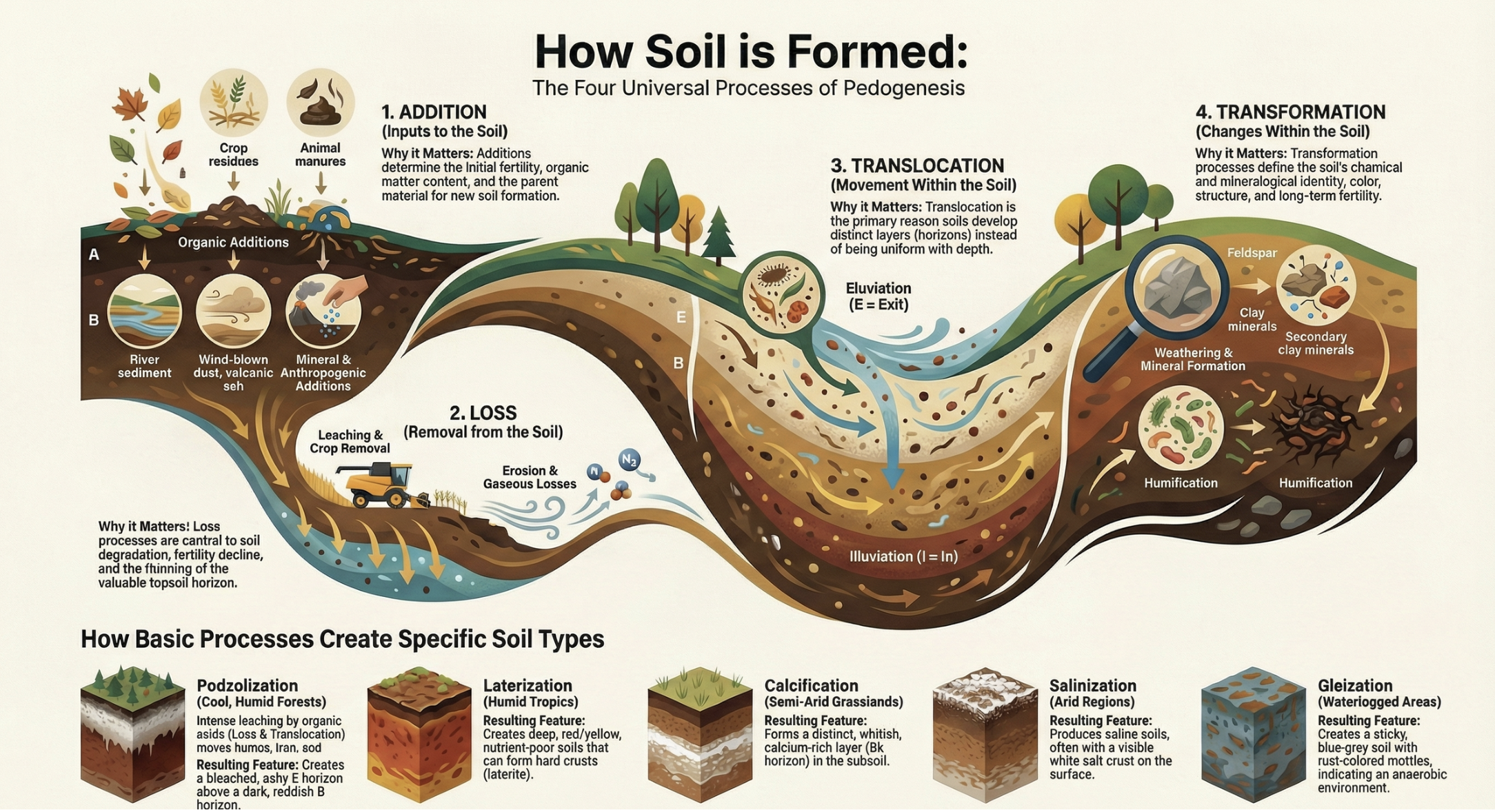
- Leaching: The downward movement of dissolved ions (Ca²⁺, Mg²⁺, K⁺, Na⁺, NO₃⁻, SO₄²⁻) in percolating water. It is dominant in high-rainfall areas and naturally acidifies the soil.
- Eluviation and Illuviation: Eluviation is the downward "washing out" of material (clay, iron, aluminum, humus) from the upper horizons. Illuviation is the "washing in" or deposition of those exact materials into a lower horizon (enriching the B horizon).
- Podzolization: Extreme eluviation found in acidic conifer forests. Chelation removes iron, aluminum, and humus from the surface, leaving a bleached white E horizon above a dark reddish subsoil (Spodosols).
- Laterization: The tropical extreme of weathering. Intense leaching removes silica and all base nutrients, leaving a residual concentration of iron and aluminum oxides. On exposure to air, this material irreversibly hardens into laterite rock.
- Calcification: Occurs in semi-arid regions where evaporation exceeds rainfall. Calcium carbonate accumulates at depth, forming white kankar nodules characteristic of Rajasthan and Gujarat soils.
- Salinization: Evaporation forces capillary water to rise, bringing dissolved salts to the surface where they precipitate as a white crust. Common in coastal Gujarat and poorly managed canal-irrigated areas.
- Gleization: Occurs under persistent waterlogging and anaerobic conditions. Red Fe³⁺ is chemically reduced to grey/blue-green Fe²⁺, creating a grey "gleyed" horizon with iron mottles, which is diagnostic of poor drainage in rice paddy soils.
5.8 Soil Profile & Horizon Classification
The soil profile is a complete vertical cross-section from the surface down to the unweathered parent rock. It acts as a visual record, revealing the entire genetic history of the soil's development.
- O Horizon: The organic layer resting above the mineral soil. It consists of forest litter in various stages of decay: Oi (fresh litter), Oe (partially decomposed), and Oa (fully humified). It is completely absent in most plowed agricultural soils.
- A Horizon: The uppermost mineral horizon, enriched with humified organic matter, giving it the darkest color of all mineral layers. It has the highest biological activity and acts as the primary zone of eluviation in wet climates.
- E Horizon: The intensely eluviated horizon, characterized by a light, grey, or bleached white color. It has been stripped of clay, iron, aluminum, and humus. It sits directly between the A and B horizons, typical of podzols and highly leached forest soils.
- B Horizon: The subsoil, representing the primary zone of illuviation (accumulation). It is subdivided based on what has accumulated:
- Bt (Argillic): Clay accumulation (the most common in Indian soils).
- Bs (Spodic): Iron, aluminum, and humus accumulation (Podzols).
- Bk (Calcic): Calcium carbonate accumulation (arid Rajasthan/Gujarat).
- By (Gypsic): Gypsum accumulation.
- Bg (Gleyed): Iron reduction resulting in a grey color (waterlogged soils).
- C Horizon: Partially weathered parent material where pedogenic (soil-forming) processes are minimal. It still retains the structural fabric of the original rock.
- R Horizon: Consolidated, impenetrable bedrock (such as granite, basalt, or limestone) that cannot be dug with hand tools.
Diagnostic Horizons (Key for Soil Classification)
- Mollic Epipedon: A dark, thick surface A horizon (greater than 25 cm deep) with a base saturation above 50%. It remains soft even when dry, defining the world's most fertile grassland soils (Mollisols).
- Argillic Horizon (Bt): A subsoil layer with a significant accumulation of translocated clay compared to the surface, often showing oriented clay skins on soil ped faces.
- Plinthite: An iron-rich, mottled subsurface material that irreversibly hardens into a brick-like rock when exposed to repeated wetting and drying, diagnostic of tropical laterite soils.
- Natric Horizon: Essentially an argillic (clay-rich) horizon that also possesses a destructive columnar structure and an Exchangeable Sodium Percentage (ESP) greater than 15%, diagnostic of severe sodic soils.
📝 Exam Focus / Past Year Question (PYQ) Hooks
- PYQ 2025 Q6(b) 20M: Lucid account of factors influencing soil formation. → To structure a perfect 20-mark answer (roughly 600–800 words), base your response entirely on Jenny's CLORPT model (Sections 5.1 through 5.6). Write one detailed, clear paragraph for each of the five factors, ensuring you explicitly include the specific Indian soil examples provided in the notes to ground your answer in a regional context.