Soil Science Ch 4. Soil Biological Properties
Soil is the most biodiverse ecosystem on Earth per unit volume. To put this into perspective, just one gram of fertile forest soil harbors approximately 600 million bacteria and 5 to 6 kilometers of fungal hyphae. These biological properties are the engine of the soil, driving critical processes such as nutrient cycling, aggregate formation, disease suppression, and long-term carbon dynamics.
4.1 Soil Bacteria
A. Abundance and Diversity
Bacteria are the most numerous and metabolically diverse group of soil organisms. A single gram of fertile agricultural topsoil contains 1 to 2 billion bacteria, though this number drops to 10 to 100 million per gram in the subsoil. In a productive hectare, bacterial biomass weighs between 300 and 600 kg, making up 50 to 60% of the total microbial biomass in most agricultural soils. The diversity is staggering; one gram of soil may contain anywhere from 10,000 to 1,000,000 different bacterial species. Currently, only about 1% of these are culturable in a laboratory, with the rest identified solely through modern DNA sequencing.
B. Classification by Oxygen Requirement
- Aerobic Bacteria: These require oxygen to survive and dominate in well-aerated soils. Most critical nitrogen-cycling bacteria, such as Nitrosomonas, Nitrobacter, and Azotobacter, fall into this category.
- Anaerobic Bacteria: These do not require oxygen and thrive in waterlogged or flooded soils. Examples include Clostridium (which performs anaerobic nitrogen fixation) and methanogens (which produce methane gas, CH₄).
- Facultative Anaerobes: These are the most versatile bacteria, capable of switching between aerobic and anaerobic respiration depending on soil conditions. Examples include Pseudomonas (responsible for denitrification) and E. coli-type organisms.
C. Key Bacterial Functions in Soil
- Decomposition: Bacteria produce extracellular enzymes (like cellulase, protease, amylase, and lipase) to break down complex organic molecules, ultimately releasing plant-available nutrients.
- Nitrogen Fixation:
- Symbiotic: Bacteria like Rhizobium and Bradyrhizobium form nodules on legume roots, fixing 150 to 300 kg of nitrogen per hectare annually.
- Free-living Aerobic: Azotobacter fixes 5 to 30 kg of N/ha per year but requires a substantial carbon substrate for energy.
- Associative (Rhizosphere): Azospirillum colonizes cereal roots and fixes 30 to 50 kg of N/ha per year.
- Free-living Anaerobic: Clostridium fixes nitrogen in waterlogged soils, though it is less efficient than aerobic fixers.
- Nitrification: A two-step aerobic process that converts ammonium to plant-available nitrate. Nitrosomonas converts ammonium (NH₄⁺) to nitrite (NO₂⁻), and Nitrobacter converts nitrite to nitrate (NO₃⁻).
- Denitrification: Under anaerobic conditions, bacteria like Pseudomonas and Thiobacillus convert nitrate (NO₃⁻) into nitrous oxide (N₂O) and nitrogen gas (N₂). This is a major pathway for nitrogen loss in poorly drained soils.
- Phosphate Solubilization: Bacteria such as Bacillus megaterium and Pseudomonas fluorescens produce organic acids (like citric and oxalic acids) that dissolve fixed phosphorus, making it available to crops.
- Sulfur Oxidation: Thiobacillus thiooxidans oxidizes elemental sulfur into sulfuric acid (H₂SO₄). This process is deliberately used to reclaim alkali soils, as the acid lowers the pH, dissolves calcium carbonate (CaCO₃), and releases calcium ions (Ca²⁺) to exchange out harmful sodium (Na⁺).
- Aggregate Formation: Bacteria secrete extracellular polymeric substances (EPS) and polysaccharides that act as a temporary biological "glue," driving the formation of soil microaggregates.
4.2 Soil Fungi
A. Abundance and Structure
While fungal colony-forming units range from 10,000 to 100,000 per gram of soil, their true impact lies in their enormous hyphal biomass, which can reach 1 to 5 kilometers of hyphae per gram in fertile soils. Their primary role is to decompose the most chemically resistant organic matter fractions—such as lignin, cellulose, and chitin—that bacteria cannot break down efficiently, perfectly complementing bacterial decomposition.
B. Mycorrhizal Fungi — The Critical Symbiosis
The term "mycorrhiza" comes from Greek (mykes = fungus, rhiza = root). It refers to an evolutionarily ancient (roughly 400 million years old), symbiotic association between soil fungi and plant roots. This relationship is nearly universal in nature, present in 85 to 90% of all plant species. It is notably absent only in a few families, such as Brassicaceae (mustards), Chenopodiaceae (spinach), Proteaceae, and sedges.
C. Arbuscular Mycorrhizae (AM / VAM)
Arbuscular mycorrhizae are the most important fungal associations for agriculture.
- Structure: Fungal hyphae penetrate the plant root cells, forming branched exchange structures called arbuscules inside the cells, and lipid storage organs called vesicles between the cells.
- Host Range: They colonize over 80% of crop plants, including rice, wheat, maize, soybean, sugarcane, legumes, and all vegetable and fruit crops.
- Primary Function (Phosphorus Acquisition): The fungal hyphae act as root extensions, reaching far beyond the phosphorus-depleted zone immediately surrounding the plant roots. This increases the soil volume explored for phosphorus by 100 to 1,000 times, improving plant phosphorus acquisition by 30 to 40%.
- Secondary Benefits: AM fungi vastly improve the uptake of zinc, copper, and iron, which is critical in alkaline Indian soils where these micronutrients are heavily fixed. They enhance drought tolerance by accessing water in tiny soil pores. They also suppress soilborne diseases by physically occupying root space, blocking pathogens like Fusarium and Pythium.
- Glomalin Production: AM fungi secrete a sticky, highly persistent glycoprotein called glomalin. It coats hyphae and soil particles, making it the most important biological stabilizer of soil macroaggregates.
- Management: Mycorrhizal networks are promoted by diverse crop rotations and reduced tillage. Conversely, they are actively suppressed by bare fallows, chemical fumigation, and excessively high phosphorus fertilization (greater than 80 kg P₂O₅/ha).
4.3 Actinomycetes
Actinomycetes are Gram-positive, filamentous bacteria that exhibit thread-like growth. While they look physically similar to fungi, they are true prokaryotic bacteria, intermediate in size between the two groups.
- Abundance: There are generally 100,000 to 1 million actinomycetes per gram of soil. While less abundant than standard bacteria, they play highly specialized ecological roles.
- Unique Functions: They specialize in decomposing the most highly resistant organic materials, including lignin, chitin, and keratin. They are also responsible for the classic "earthy smell" of freshly tilled soil, which is caused by a compound called geosmin produced by Streptomyces species.
- Antibiotic Production: Historically, antibiotics like streptomycin, erythromycin, and tetracycline were first isolated from soil Streptomyces. In the soil, they use these compounds to naturally suppress competing pathogens.
- Nitrogen Fixation: Frankia species form symbiotic nitrogen-fixing relationships with non-legume trees, such as Casuarina and alder.
- Ecology: Actinomycetes strongly prefer a neutral to alkaline pH (6.5 to 8.5) in well-aerated, slightly moist soils. Their populations drop sharply below pH 6.0, and they are entirely absent from highly acidic forest soils.
4.4 Algae & Cyanobacteria
Soil algae and cyanobacteria are primarily found in the sunlit surface layers of the soil, with populations ranging from 10,000 to 100,000 per gram. The major types include green algae, blue-green algae (cyanobacteria), and diatoms. They are especially prevalent in flooded rice fields, irrigated lands, and wet tropical soils.
- Photosynthesis: They utilize sunlight to fix atmospheric CO₂ into organic matter, effectively building soil carbon even on bare, unplanted surfaces.
- Nitrogen Fixation: Cyanobacteria species like Anabaena, Nostoc, and Aulosira can fix 20 to 40 kg of nitrogen per hectare per season, providing a crucial free nitrogen source in flooded rice paddies.
- Biological Soil Crusts: In arid environments, algal and cyanobacterial films bind surface particles together, forming biological crusts that successfully prevent wind and water erosion.
- Azolla-Anabaena Association: This is a classic green manure system used in South and Southeast Asian rice production. The aquatic fern Azolla hosts Anabaena azollae bacteria inside its leaf pockets. Together, they can fix up to 100 kg of nitrogen per hectare during the wet season.
- BGA Inoculants: Commercial cultures of blue-green algae can be applied directly to flooded rice fields. Under sunlight, they multiply and fix 20 to 40 kg of N/ha, allowing farmers to substitute 25 to 30% of their standard synthetic urea dose.
4.5 Protozoa
Protozoa are unicellular eukaryotes, primarily consisting of flagellates, amoebae, and ciliates. In moist, fertile soils, they number between 10,000 and 100,000 per gram.
- Bacterial Regulation: Their primary ecological role is preying on bacteria. By grazing on bacterial colonies, they regulate populations and prevent any single bacterial group from entirely dominating the soil ecosystem.
- The Microbial Loop: Bacteria have a very narrow C:N ratio (about 5:1), meaning they hold a lot of nitrogen. When protozoa consume bacteria, they ingest more nitrogen than they need. They excrete this excess nitrogen as ammonium (NH₄⁺), which is immediately available for plant uptake. This process dramatically accelerates soil nitrogen cycling.
- Stimulatory Effect: Just as pruning a hedge encourages new growth, protozoan grazing pressure actually stimulates faster bacterial growth rates, ultimately leading to more total nitrogen being mineralized over time.
- Indicator Value: A high protozoa count indicates a massive, highly active bacterial community, signifying excellent biological soil health. Conversely, low protozoa counts indicate a degraded biological system.
4.6 Soil Fauna — Earthworms & Others
A. Earthworms — Ecosystem Engineers
Earthworms are the premier physical engineers of the soil. In fertile soils, populations range from 50 to 500 per square meter, but can reach up to 5 million per hectare in organic-rich temperate soils. Through ingestion and casting, earthworms process and move an incredible 10 to 50 tonnes of soil per hectare annually, acting as the primary mixing force in the upper soil profile.
- Physical Functions: Their burrowing creates a vast network of macropores, which provides pathways for plant roots and can increase water infiltration rates by 10 to 100 times. Their casts (excrement) deposited at the surface are highly water-stable aggregates that improve surface structure and slow erosion.
- Chemical Functions: Earthworm casts are nutrient goldmines. Compared to surrounding soil, casts contain 5 times more nitrogen, 7 times more available phosphorus, 11 times more nitrate, and double the calcium. Furthermore, as soil passes through the earthworm gut, resistant organic matter is broken down 2 to 3 times faster.
- Biological Functions: The microbial population inside an earthworm cast is 10 to 100 times higher than in the surrounding bulk soil, making casts intense microbial hotspots. Worms also physically transport bacterial and fungal spores throughout the soil profile.
- Vermicompost: Commercial earthworm species like Eisenia fetida are used to rapidly break down organic waste. Vermicomposting takes only 30 to 60 days (compared to 6 months for traditional farmyard manure) and yields a heavily nutrient- and microbe-enriched fertilizer.
B. Other Key Fauna
- Nematodes: The most abundant multicellular organisms in the soil (1 to 10 million per square meter). They include beneficial bacterial and fungal feeders, predators, and harmful plant-parasitic types (like root-knot and cyst nematodes). Beneficial nematodes, like protozoa, help release nitrogen by consuming bacteria.
- Mites (Acari): The dominant fauna in the surface litter layer. They act as shredders, physically ripping apart fresh plant litter to expose maximum surface area to microbial attack, accelerating decomposition by 3 to 5 times.
- Springtails (Collembola): These feed primarily on fungi. They regulate fungal growth and disperse fungal spores, acting as vital secondary decomposers in forest ecosystems.
- Termites: A major force in tropical soils, termites decompose tough wood and cellulose. By constructing large mounds, they facilitate deep soil mixing, which is especially important in Peninsular India, though they can occasionally become pests in planted commercial forests.
4.7 Soil Health
A. Definition
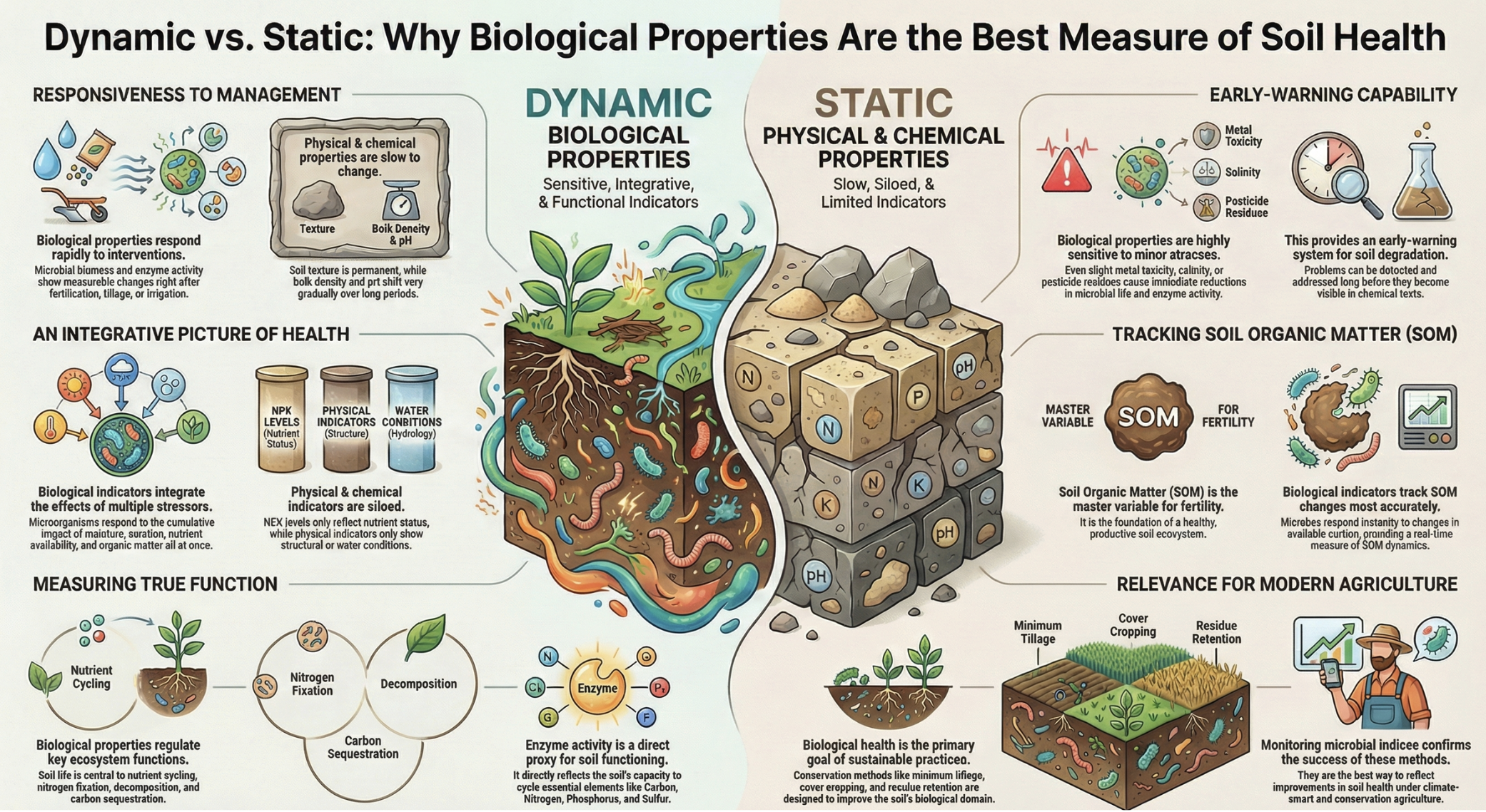
Soil health is defined as the continued capacity of the soil to function as a vital, living ecosystem that sustains plants, animals, and humans. It is a much broader and more integrated concept than "soil fertility." While soil fertility refers strictly to the chemical presence of nutrients, soil health encompasses the physical, chemical, and biological aspects operating simultaneously. A fertile soil might only be capable of growing a crop with heavy inputs, but a truly healthy soil reliably produces crops, purifies water, cycles its own nutrients, stores carbon, and supports immense biodiversity.
B. Indicators of Soil Health
To accurately assess soil health, scientists look at three categories of indicators:
Physical Indicators:
- Bulk Density: A healthy bulk density is <1.4 g/cm³ for clay soils and <1.6 g/cm³ for loams. Higher numbers indicate severe compaction.
- Aggregate Stability (MWD): Good structural health requires >60% of macroaggregates to be completely water-stable.
- Water Infiltration: Rates >2 cm/hour indicate healthy, open macropores, while rates <0.5 cm/hour indicate surface sealing and blockage.
- Effective Rooting Depth: Healthy soils offer >60 cm of unrestricted downward root growth.
Chemical Indicators:
- Soil Organic Carbon (SOC): The single most responsive indicator to farm management. A minimum of 0.8% is required, though >2.0% is ideal.
- pH: A range of 6.0 to 7.5 ensures optimal nutrient availability.
- Cation Exchange Capacity (CEC): A CEC of >12 cmol/kg indicates adequate long-term fertility potential.
- Electrical Conductivity (EC): An EC of <1 dS/m indicates the soil is non-saline and healthy.
- Nutrient Levels: Having adequate baseline availability of N, P, K, Zn, S, and Fe based on critical threshold tests.
Biological Indicators:
- Microbial Biomass Carbon (MBC): MBC levels >100 mg C/kg indicate moderate biological activity, while >400 mg C/kg indicates a highly active, exceptionally healthy biological system.
- Earthworm Population: The simplest visible field indicator. Finding >50 worms per square meter proves excellent health, while finding <5 suggests heavy degradation.
- Dehydrogenase Enzyme Activity: This measures the total metabolic rate of the soil microbial community and is highly sensitive to pesticide overuse and physical compaction.
- CO₂ Respiration Rate: Measures active decomposition and microbial breathing in the soil.
C. Soil Health Card (SHC) Scheme — India
- Launch: The scheme was launched on February 19, 2015, executed by the Department of Agriculture, Cooperation & Farmers Welfare.
- Testing Parameters: The cards report on 12 specific chemical parameters: pH, EC, Organic Carbon, Available N, P, K, S, Zn, Fe, Cu, Mn, and B.
- Sampling Protocol: Testing occurs once every two years, taking one GPS-tagged sample per 2.5 hectares in irrigated areas, or 10 hectares in rainfed areas.
- Output: Farmers receive crop-specific fertilizer recommendations, advice on using lime or gypsum for reclamation, and suggestions for organic inputs.
- Impact: Over 200 million cards were issued by 2022-23, leading to a reported 8 to 10% reduction in the blind overuse of chemical fertilizers in pilot districts.
- Limitations: The scheme's major flaw is that it focuses entirely on chemical parameters; no vital biological indicators (like MBC, earthworm counts, or enzyme activity) are tested. Furthermore, follow-up agricultural extension services remain weak in many states.
📝 Exam Focus / Past Year Question (PYQ) Hooks
- PYQ 2017 Q1(e) 10M: Soil Health — define and discuss. → To score a full 10 marks on this question within this section alone, combine section 4.7A (The broad definition comparing health vs. fertility), 4.7B (Categorize your answer explicitly into Physical, Chemical, and Biological indicators), and conclude with 4.7C (A brief mention of the SHC scheme to show practical administrative knowledge).