India faces a paradox in its food system that often goes unnoticed. While the country grows more than enough grain and exports the surplus, it remains highly protein-deficient and heavily dependent on imports. A massive missed opportunity lies dormant in crops that Indian farmers stopped cultivating decades ago.
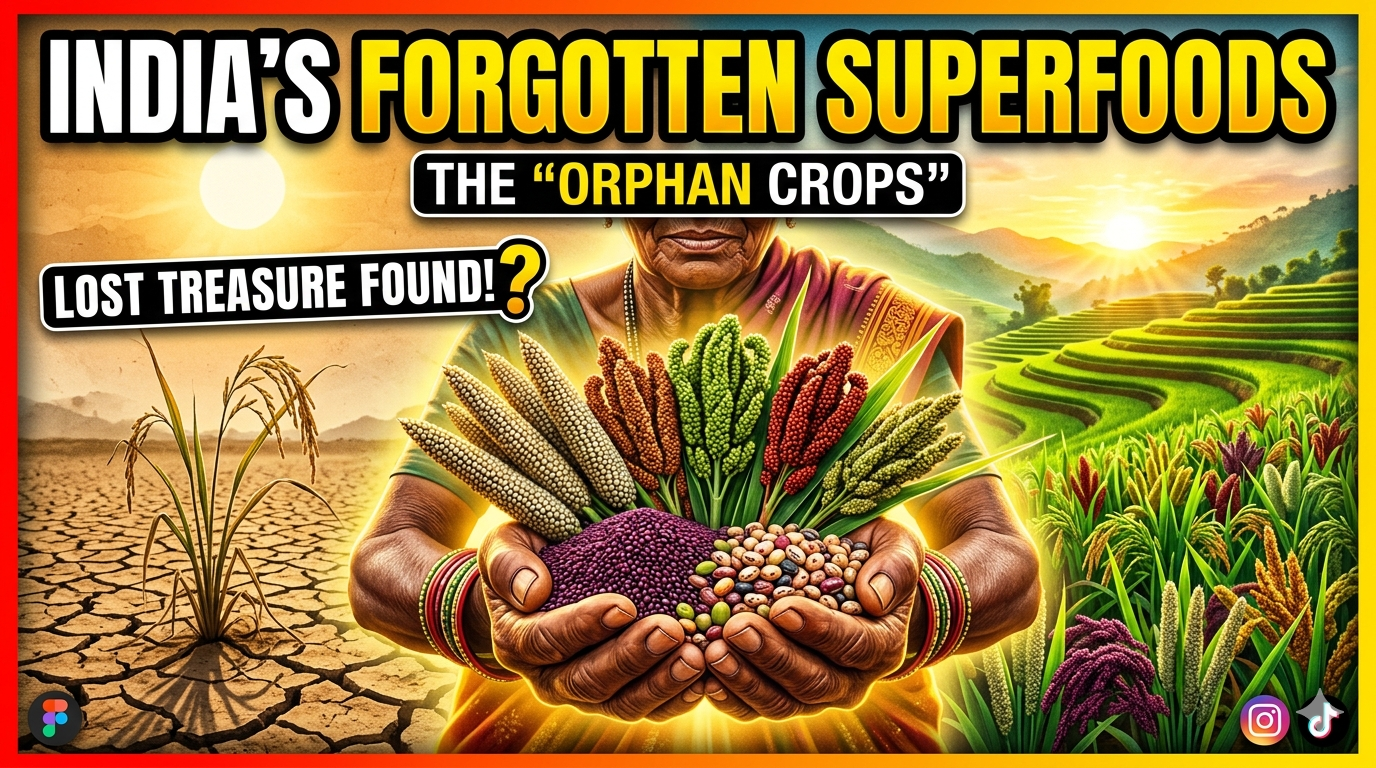
India produces an extraordinary amount of rice, leading the world in exports. Yet, the nation spends tens of thousands of crores annually importing cooking oil and pulses, while a significant portion of its population lacks access to sufficient, high-quality protein. According to a new report by the Good Food Institute (GFI) India, the solution may lie in "orphan crops"—traditional plants that have been long abandoned.
The core argument is straightforward: to secure its nutritional and economic future, India must transition away from its over-reliance on a few staple grains and revive the cultivation and consumption of diverse, protein-rich traditional plants.
What are 'Orphan Crops'?
Orphan crops are essentially India's forgotten foods.
For centuries, these hardy, nutritious plants were a staple in various regions, perfectly adapted to local soils. However, the Green Revolution shifted the entire agricultural focus toward wheat and rice, leaving these traditional crops behind. Without government procurement, assured markets, research funding, or irrigation support, both farmers and consumers gradually abandoned them.
Today, they are often labeled as neglected, underutilised, or minor crops—though agricultural experts argue that "minor" severely misrepresents their value.
The GFI report highlights several of these crops:
-
Horse gram (known as kulthi in the north and kollu in the south)
-
Winged bean
-
Grass pea (khesari)
-
Lupin
-
Bambara groundnut
-
Various indigenous millets and legumes
These crops share vital traits: they are highly protein-rich, resilient against climate stress and drought, and require significantly fewer pesticides and fertilisers than conventional crops.
Protein Content of Orphan Crops
(Note: Protein levels vary based on growing conditions and variety; these are indicative ranges and should be cross-referenced with ICAR or National Institute of Nutrition data).
-
Horse gram (kulthi/kollu): Contains roughly 22–24% protein. It features a low glycaemic index (preventing rapid blood sugar spikes) and thrives primarily in dryland and southern India.
-
Bambara groundnut: Often considered a near-complete food due to its excellent balance of carbohydrates and protein. It typically offers 18–25% protein alongside a solid amino-acid profile.
-
Winged bean: Nicknamed the "soybean that climbs," nearly every part of this plant is edible (seeds, pods, leaves, roots). Its seed protein content is comparable to soybean, ranking it among the most protein-dense food plants.
-
Lupin: A legume boasting exceptionally high protein levels. While not widely eaten in India yet, it is actively used in plant-protein products globally.
-
Millets (Shree Anna): Offering 7–12% protein, they are lower in protein than legumes but compensate by being dense in fibre and micronutrients like iron, calcium, and vitamin B.
The GFI report also highlights a severe vulnerability in the global food supply. Of the approximately 30,000 edible plant species worldwide, only about 170 are grown commercially. Even more alarming, just four crops—rice, maize, wheat, and potatoes—provide nearly 60% of all global calories. A similarly narrow base supplies the world's plant-based protein, creating a precarious situation as climate change accelerates.
India's Hidden Protein Crisis
India's relationship with protein is complex. The country does not suffer from a calorie deficit; the food system successfully delivers energy. However, it fails to provide adequate, high-quality protein.
-
A widely cited (though industry-linked) survey from 2017 indicated that roughly 73% of Indians were protein-deficient, with the vast majority unaware of their daily protein requirements.
-
In December 2025, the Council on Energy, Environment and Water (CEEW) analyzed India's 2023–24 National Sample Survey data. It revealed that nearly 50% of home-consumed protein comes from cereals (rice, wheat, suji, maida). The National Institute of Nutrition advises that only 32% of protein should come from cereals. Over-reliance on cereal protein is problematic because it is lower in digestibility and lacks a complete amino acid profile, crowding out superior protein from pulses and dairy.
-
In February 2026, a survey by LocalCircles and Country Delight (over 2 lakh responses across 25 cities) showed that about 60% of urban Indians skip daily protein-rich foods, primarily due to affordability.
For vegetarian households, pulses are the ideal solution, providing lysine—the amino acid missing in cereals. While the recommended pulse intake is about 80 grams per person per day, actual Indian consumption has historically been roughly half that amount, contributing only 20–25% of the average diet's protein.
Ultimately, India is not short on food; it is short on affordable, high-quality protein. Reviving orphan crops could directly bridge this gap.
An Economic Imbalance: Exporting Grain, Importing Oil and Protein
India's agricultural economics present an uncomfortable reality: the country is the world's biggest rice exporter, yet simultaneously the world's largest importer of edible oil and a major importer of pulses.
Edible Oil
In 2024–25, India imported between 16 and 16.5 million tonnes of edible oil. Depending on the estimate, this covered over 50% to more than 60% of domestic demand. The Agriculture Ministry estimates this costs the nation approximately ₹80,000 crore annually. (Note: Exact import dependence figures vary between 56% and over 60%; always verify with sources like DGCIS or the Solvent Extractors' Association). India is spending close to a lakh crore yearly on a commodity it could cultivate domestically.
Pulses
While domestic pulse production has grown from 192 lakh tonnes in 2013–14 to about 252 lakh tonnes in 2024–25, it remains insufficient. India still imported around 47 lakh tonnes in 2023–24. In 2024–25, following government duty cuts to stabilize dal prices, imports hit a record of roughly 7 million tonnes. Major sources include Mozambique, Tanzania, and Myanmar for tur (pigeon pea), and Canada, Russia, and Australia for masoor and peas.
The "Smart Protein" Sector
The domestic plant-based food industry (meat/dairy alternatives and protein powders) relies heavily on protein ingredients imported from China and Europe. India currently lacks the processing-grade peas, soy, and chickpeas needed for these products. High import duties and logistics costs make these alternatives significantly more expensive than conventional animal products, limiting their market reach in India.
The Billion-Dollar Opportunity
The GFI report frames this challenge as an untapped economic goldmine.
Currently, India sells most of its harvest as low-value raw grain. Converting these crops into protein concentrates, plant-based meats, dairy alternatives, and functional foods drastically increases their economic value. The global demand for these processed, high-margin items is surging.
The report notes the global plant-based meat market could hit between $88 billion and $368 billion by 2035. While this is a broad, long-range scenario rather than a strict forecast, it highlights a massive export opportunity. With its agricultural diversity and scientific prowess, India could supply protein ingredients to the world.
Other nations are already capitalizing on this. Canada and Australia have robust industries built on peas, lentils, and legumes. China and The Netherlands possess the processing infrastructure to transform alternative crops into high-value foods. For India to follow suit, it must invest heavily in processing factories and value-addition, not just raw farming output.
Current Government Initiatives
India is already implementing policies that align with this shift, though they need to be scaled up:
-
National Food Security Mission (NFSM): Launched in 2007–08, its pulses component spans 28 states and 2 UTs to boost pulse area and productivity via better seeds and farming support.
-
Mission for Aatmanirbharta (Self-Reliance) in Pulses: Announced in the Union Budget 2025–26, approved in October 2025, and launched in New Delhi on October 11, 2025. This ₹11,440 crore mission runs for six years (2025–26 to 2030–31) and targets the three pulses with the highest production gaps: tur, urad, and masoor. NAFED and NCCF will procure 100% of eligible produce at Minimum Support Price for four years, removing price risk for roughly 2 crore farmers. (Verify exact procurement targets with official PIB documents).
-
National Mission on Edible Oils – Oil Palm (NMEO-OP): Launched in 2021 to cut import dependence by expanding domestic oil-palm cultivation.
-
PM-AASHA (2018): Offers price support and procurement assurance for pulses, oilseeds, and copra.
-
Millets Initiative: India spearheaded the UN's declaration of 2023 as the International Year of Millets (backed by 72 countries). Rebranded as "Shree Anna", millets have been integrated into public distribution, mid-day meals, and exports, with ICAR-IIMR in Hyderabad designated as a global centre of excellence.
These initiatives align with the GFI report's recommendations. The goal now is to accelerate these efforts and integrate a processing and protein industry framework.
Why Progress is Slow (And a Health Warning)
Transitioning away from a cereal-dominated system is structurally difficult for several reasons:
-
Systemic Bias: The entire agricultural support network (procurement, irrigation, subsidies) is designed for rice and wheat. Pulses and oilseeds face high price volatility and patchy procurement, making them risky for farmers.
-
Low Productivity: Yields for pulses and oilseeds are far below potential due to a lack of quality seeds, irrigation, machinery, and localized advice.
-
Weak Infrastructure: Post-harvest storage, processing units, and reliable buyers are scarce for lesser-known crops, discouraging farmers from making a permanent switch.
-
Supply Chain Hurdles: Food companies require high-volume, consistent-quality inputs. Because domestic yields are low, the industry continues to import raw materials.
Health Caution: Grass Pea (Khesari)
One crop requires a specific health warning. Grass pea (khesari) is highly nutritious but contains β-ODAP, a natural compound. Consuming large quantities over long periods (often during poverty-induced food scarcity) can lead to lathyrism, a form of lower-limb paralysis. Historically, this led to bans on the crop in several states. However, scientists have now developed low-ODAP varieties that drastically reduce this risk, sparking renewed interest. (Note: The link between β-ODAP and lathyrism is verified, but state-by-state regulatory status should be checked for current updates).
The Path Forward
The GFI report outlines a comprehensive field-to-shelf pipeline:
-
Regional Mapping: Identify which orphan crops suit specific agro-climatic zones rather than forcing a one-size-fits-all approach.
-
Plant Breeding: Invest in developing varieties with higher yields, better protein content, drought resistance, and shorter growing seasons.
-
Extraction Technologies: Develop industrial processes capable of extracting concentrated protein from raw crops to supply food manufacturers.
-
Supply Chain Development: Build commercially viable networks—procurement, cold storage, processing, and market linkages—to make domestic sourcing profitable for both farmers and corporations.
Finally, the report suggests a crucial paradigm shift in agricultural policy. Historically, success was measured by yield (kilograms of grain per hectare), which eliminated famine but ignored nutrition. The next phase of policy must track protein per hectare—the amount of high-quality protein a plot of land actually generates.
Addressing the protein gap, lowering the import bill, and creating a robust plant-protein export sector are not three separate problems. They are a single challenge with a shared solution.