The story so far
On June 5 every year, the world marks World Environment Day. The 2026 theme places climate change at the centre of the conversation. For India, that conversation cannot begin anywhere except with the air we breathe.
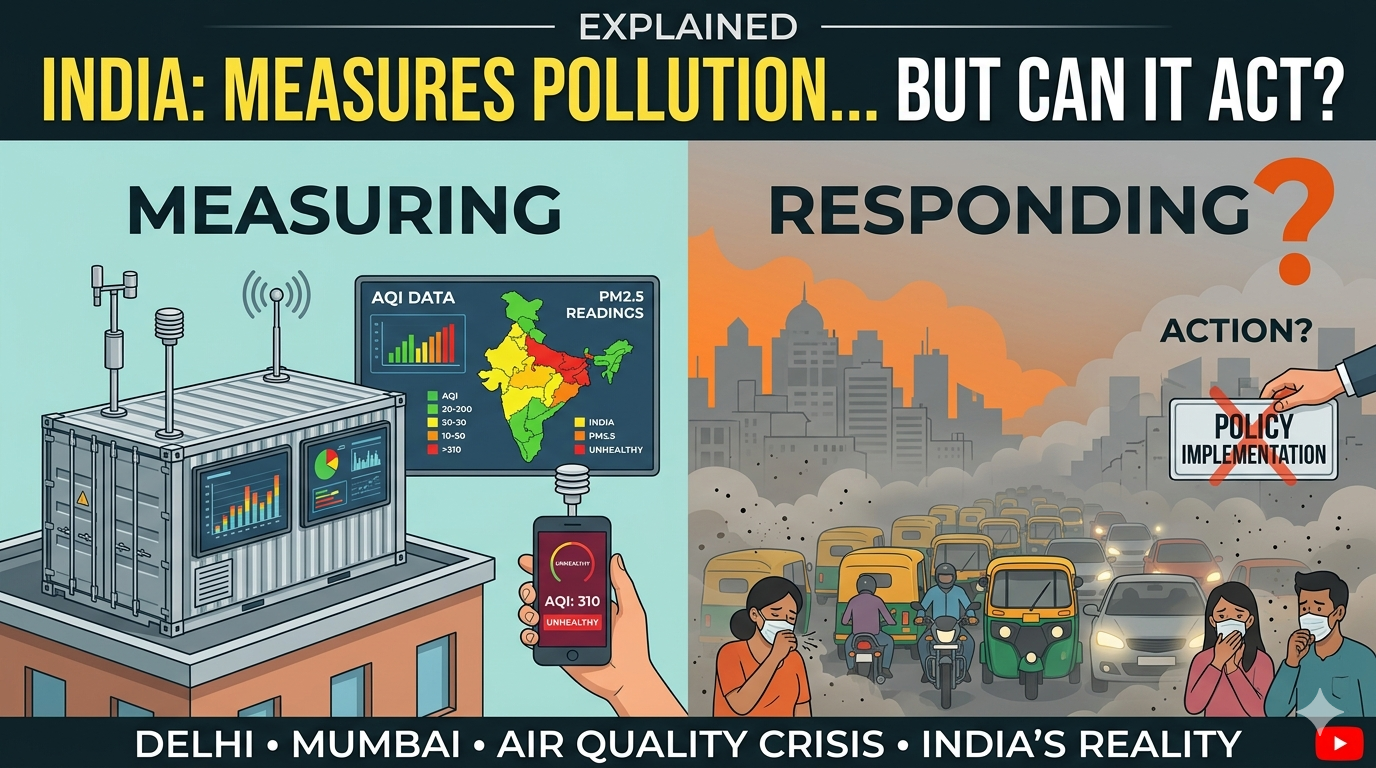
India has done the difficult, expensive work of building the measurement layer. The Central Pollution Control Board (CPCB) launched the Sameer app in 2016 to put real-time Air Quality Index data in the hands of citizens. A revamped version, Sameer 2.0, was released on CPCB's 51st Foundation Day in September 2025, with a cleaner interface, location-based services and improved engagement features. By 2025, India reportedly had around 1,600 air quality monitoring stations across 584 cities, including roughly 565 continuous ambient stations and 1,035 manual stations (these figures come from a CREA progress report and should be cross-checked with CPCB before quoting).
The data is there. The dashboards are there. The app is there.
What is missing, a recent commentary in Down To Earth by researchers from the Pahle India Foundation's PAVANA Centre for Air Pollution & Environmental Health has argued, is the response system. When the AQI in your city reads 320 — "very poor" — what is your child's school actually expected to do? What is the district health officer expected to do? What does an ASHA worker tell a pregnant woman? At present, there is no national protocol that ties specific air quality thresholds to a defined health response.
This explainer walks through the five Ws — what the systems are, why the gap matters, when they were built, where the failure shows up, and who carries the heaviest burden — and what India can do about it.
What is the Sameer app, in simple words?
Sameer is a free Android and iOS app developed by the Central Pollution Control Board under the Ministry of Environment, Forest and Climate Change.
It does two things. First, it shows you the National Air Quality Index (AQI) for your city in real time, drawing from CPCB's network of continuous monitoring stations. Second, it carries a grievance redressal channel — a citizen can photograph a burning garbage heap or a smoke-belching truck and file a complaint directly with CPCB. The complaint is meant to be routed to the relevant State Pollution Control Board for action.
This is the digital expression of Jan Bhagidari — public participation — applied to environmental accountability. The intent is to move the citizen from being a passive recipient of data to an active participant in pollution control.
The original Down To Earth commentary notes a sobering reality check, however. As of May 2026, nearly a decade after launch, Sameer reportedly carries a 2.3-star rating on Google Play across roughly 1,700 reviews and more than 100,000 downloads — in a country of 1.4 billion people. In Hyderabad, the same source notes, 96 citizen complaints filed through Sameer remained unresolved as of January 2025, with CPCB itself acknowledging that outside the National Capital Region (NCR), the app simply forwards complaints by email to State Pollution Control Boards. The chain breaks if no one is reading the inbox. (Aspirants should verify these specific figures from the original Deccan Chronicle reporting that Down To Earth cites.)
What is the AQI and what do the categories mean?
The National Air Quality Index was launched in India in 2014–15 under the "Swachh Bharat" initiative. It was developed with technical input from IIT Kanpur and an expert group of medical professionals, scientists and pollution control board officials.
The AQI converts complex air quality data into a single, easy-to-read number on a 0–500 scale, with six colour-coded categories:
- 0–50: Good (minimal impact)
- 51–100: Satisfactory (minor breathing discomfort to sensitive people)
- 101–200: Moderate (breathing discomfort to people with lung, asthma and heart diseases)
- 201–300: Poor (breathing discomfort to most people on prolonged exposure)
- 301–400: Very Poor (respiratory illness on prolonged exposure)
- 401–500: Severe (affects healthy people and seriously impacts those with existing diseases)
The index is calculated from concentrations of eight pollutants: PM2.5 (fine particulate matter less than 2.5 micrometres), PM10 (coarser particulate matter), NO₂ (nitrogen dioxide), SO₂ (sulphur dioxide), CO (carbon monoxide), O₃ (ozone), NH₃ (ammonia) and Pb (lead). The worst sub-index across these eight pollutants becomes the overall AQI.
A critical point for any aspirant or citizen: India's own ambient air quality standards are significantly weaker than World Health Organization (WHO) guidelines. India's annual PM2.5 standard is 40 micrograms per cubic metre; the WHO guideline is 5. That is an eight-fold gap. It means India's own "Good" can still be far above what global health science considers safe.
Why is air pollution such a big problem in India?
Because it kills, and at a scale most other risk factors cannot match.
A widely cited Lancet Planetary Health study published in December 2024, led by researchers from Karolinska Institutet, Harvard, Ashoka University and the Centre for Chronic Disease Control, estimated that long-term exposure to PM2.5 pollution is linked to approximately 1.5 million additional deaths every year in India, compared with a counterfactual where India met WHO air quality guidelines. The same study reported that essentially the entire population of India — nearly 1.4 billion people — lives in areas where PM2.5 levels exceed WHO limits.
A separate Lancet Planetary Health paper from July 2024, focused on ten major Indian cities (including Delhi, Mumbai, Chennai, Kolkata, Bengaluru, Hyderabad, Ahmedabad, Pune, Shimla and Varanasi), estimated that 7.2 per cent of all daily deaths in these cities are attributable to short-term PM2.5 exposure above WHO levels — translating to roughly 33,000 additional deaths per year across these ten cities alone.
These are very large numbers, drawn from peer-reviewed research. Readers should treat them as careful epidemiological estimates rather than precisely counted deaths — air pollution is a contributing factor in deaths that are formally attributed to heart attacks, strokes, lung disease, cancer and respiratory infection.
The point is straightforward: air pollution in India is now a public health emergency of the same order of magnitude as tobacco or undernutrition.
When were India's response systems set up?
A short timeline helps:
- 1984: India's modest air quality monitoring programme begins.
- 2014–15: The National Air Quality Index is launched.
- 2016: Sameer app launched by CPCB.
- January 2019: The National Clean Air Programme (NCAP) is launched by the Ministry of Environment, Forest and Climate Change.
- 2017: Graded Response Action Plan (GRAP) notified by the Environment Pollution (Prevention & Control) Authority for the Delhi-NCR region — a response mechanism that triggers specific actions (construction bans, school closures, traffic restrictions, anti-smog gun deployment) at defined AQI thresholds.
- 2022: NCAP target revised — 40 per cent reduction in PM10 concentrations by 2025–26, compared with a 2017–18 baseline.
- September 2025: Sameer 2.0 released.
- January 2026: A CREA assessment finds that only 51 of 100 NCAP cities with adequate data achieved the original 20–30 per cent PM10 reduction target, and only 23 cities achieved the revised 40 per cent target. 23 cities recorded an actual increase in PM10 levels since the programme began.
India, in other words, has been building both monitoring and response infrastructure for a decade. The frustration the Down To Earth commentary captures is that the response infrastructure has remained largely city-specific (Delhi-NCR) and emergency-focused (GRAP), rather than being absorbed into the everyday workings of the public health system.
Where does the response gap show up most sharply?
In four places, all of them institutional:
One — schools. When the AQI crosses 300 in a city outside Delhi, there is no national protocol that tells a school principal whether to cancel outdoor sports, shift PE indoors, or adjust the timings of morning assembly. Some states have issued ad hoc circulars; most have not.
Two — primary health centres. A district health officer faced with three consecutive days of "very poor" air has no administrative trigger to issue a public advisory, mobilise extra OPD capacity for respiratory cases, or adjust care pathways for high-risk patients. There is no national standard operating procedure.
Three — disease programmes. Air pollution is a documented risk factor for tuberculosis, yet India's TB elimination programme and its air quality monitoring systems operate in separate institutional silos under different ministries. The lung-cancer care guidelines used in Indian hospitals do not, at present, treat sustained pollution spikes as a clinical event requiring response.
Four — frontline health workers. ASHAs (Accredited Social Health Activists) and Auxiliary Nurse Midwives (ANMs) receive little standardised training on how to incorporate air quality risks into routine counselling of pregnant women, children with asthma, or cancer patients undergoing treatment.
This is the heart of the Down To Earth argument: India does not lack data. It lacks the institutional connective tissue between data and decision.
Who is most at risk?
The smartphone-owning urban professional who downloads Sameer is rarely the worst affected. The biggest burdens fall on people the app cannot reach:
- Construction workers and outdoor labourers, who are exposed when the AQI is at its worst with little protective equipment.
- Families in poorly ventilated homes in coal-belt districts, where indoor air pollution from biomass cooking compounds the outdoor problem.
- Pregnant women, where PM2.5 exposure is linked to higher risks of low birth weight, premature delivery and developmental issues for the foetus.
- Children with asthma, whose hospital visits visibly track air quality.
- TB patients, for whom polluted air worsens lung function and treatment outcomes.
- Lung cancer patients, for whom every sustained spike, in the words of the original commentary, is "a clinical event that no Indian care guideline currently accounts for".
- Elderly people with cardiovascular and respiratory conditions, who carry a higher mortality risk per increment of PM2.5.
A 2024 study in GeoHealth found that the combination of outdoor PM2.5 above India's own standards plus household air pollution from indoor cooking sharply raises the risk of neonatal, child and adult death. For poor households, the two exposures rarely separate.
What do working response systems look like elsewhere?
The Down To Earth commentary points to three peer-reviewed comparisons:
- AirForU in the United States — a personal air quality app that links AQI data to user-specific health recommendations.
- AirRater in Australia — combines location, real-time pollution data and user health symptoms (asthma, hay fever, eye irritation) to issue personalised alerts.
- Canada's Air Quality Health Index (AQHI) alert programme — explicitly linked to provincial public health advisories and primary care guidance.
The consistent finding across these systems, the commentary notes, is that information changes behaviour only when it is paired with health-linked messaging, personalised design and active community engagement. A number on a screen, by itself, doesn't move people. A number on a screen tied to "today is a high-risk day for your asthma — here is what to do" does.
India's GRAP system in Delhi-NCR is structurally closer to this model — it triggers concrete actions at defined thresholds. The question PAVANA's researchers raise is whether GRAP-style response logic can be scaled nationally, and absorbed into the public health system rather than remaining a pollution-control protocol.
What are the main problems?
Pulling the threads together, five problems stand out:
1. Disconnected ministries. Air quality sits under the Ministry of Environment, Forest and Climate Change. Public health sits under the Ministry of Health and Family Welfare. Frontline health workers sit under the National Health Mission. School safety sits under state education departments. They rarely coordinate around air pollution.
2. No national health-response protocol. There is no equivalent of GRAP at the national level that translates AQI thresholds into school, clinic and ASHA-level actions.
3. NCAP underperformance. Per the CREA assessment of January 2026, only a fraction of NCAP cities are on track to meet the revised 40 per cent reduction target. Fund utilisation has reportedly been around 51–67 per cent in different categories — meaning even allocated money isn't being fully spent.
4. Weak national standards. India's own PM2.5 standards remain significantly above WHO guidelines, which means the AQI can read "moderate" or "satisfactory" while still presenting real health risk by global benchmarks.
5. App reach versus population reach. The most affected populations are the least likely to be using a smartphone app to track air quality.
What are the possible solutions?
The directions emerging from policy researchers, including PAVANA, CREA and CSE, broadly converge:
- Build a national-level "Health GRAP" that triggers specific actions in schools, primary health centres and district administrations once the AQI crosses defined thresholds for a defined duration.
- Integrate air quality into existing health programmes — the TB elimination programme, the National Programme for Prevention and Control of Cancer, Diabetes, CVD and Stroke (NPCDCS), the Reproductive and Child Health programme, and the National Health Mission's frontline training modules.
- Train ASHAs and ANMs to incorporate air pollution counselling into routine home visits, especially for pregnant women, asthma patients, TB patients and elderly cardiac patients.
- Strengthen the Sameer redressal pipeline beyond Delhi-NCR, with a real accountability layer for State Pollution Control Boards.
- Move India's ambient air quality standards closer to WHO guidelines, in a phased manner, to make the AQI itself a more honest health signal.
- Expand and improve continuous monitoring, particularly in smaller cities — CREA's 2026 report notes that 28 NCAP cities still lack continuous ambient air quality monitoring stations.
- Source apportionment for every NCAP city, so that pollution-control money is spent on the right sources rather than on visible but marginal interventions.
Why does this matter?
Air pollution is one of the largest preventable health risks in India. The country has built, over a decade, a credible measurement infrastructure — the AQI, the Sameer app, NCAP, around 1,600 monitoring stations. That is genuine progress.
The next phase, as the PAVANA commentary frames it, is "from measurement to movement". A number on a phone screen does not protect a construction worker in Delhi, a lung cancer patient in Lucknow, or an asthmatic child in Patna. What protects them is a school that closes the playground, a primary health centre that issues an advisory, an ASHA who knows what to counsel, and a district administration that has a clear protocol for action.
World Environment Day is a useful moment to mark that distinction. Measuring polluted air is necessary, but no longer sufficient. The signal India now needs to send back to its citizens — and to the planet — is not another dashboard or another app. It is a response architecture, embedded inside the public health system, that moves every time the air does.
For UPSC and MPSC aspirants, this is a topic that cuts cleanly across:
- GS Paper 2: governance, government policies, schemes (NCAP, GRAP, Sameer), health
- GS Paper 3: environment and ecology, air pollution, climate change, conservation
- Essay paper: public health, environment and development, Jan Bhagidari and citizen participation
- Ethics paper: the moral dimension of environmental harm falling disproportionately on the poor
Expect questions on the institutional architecture of air quality management, the gap between monitoring and action, and possible reform pathways.