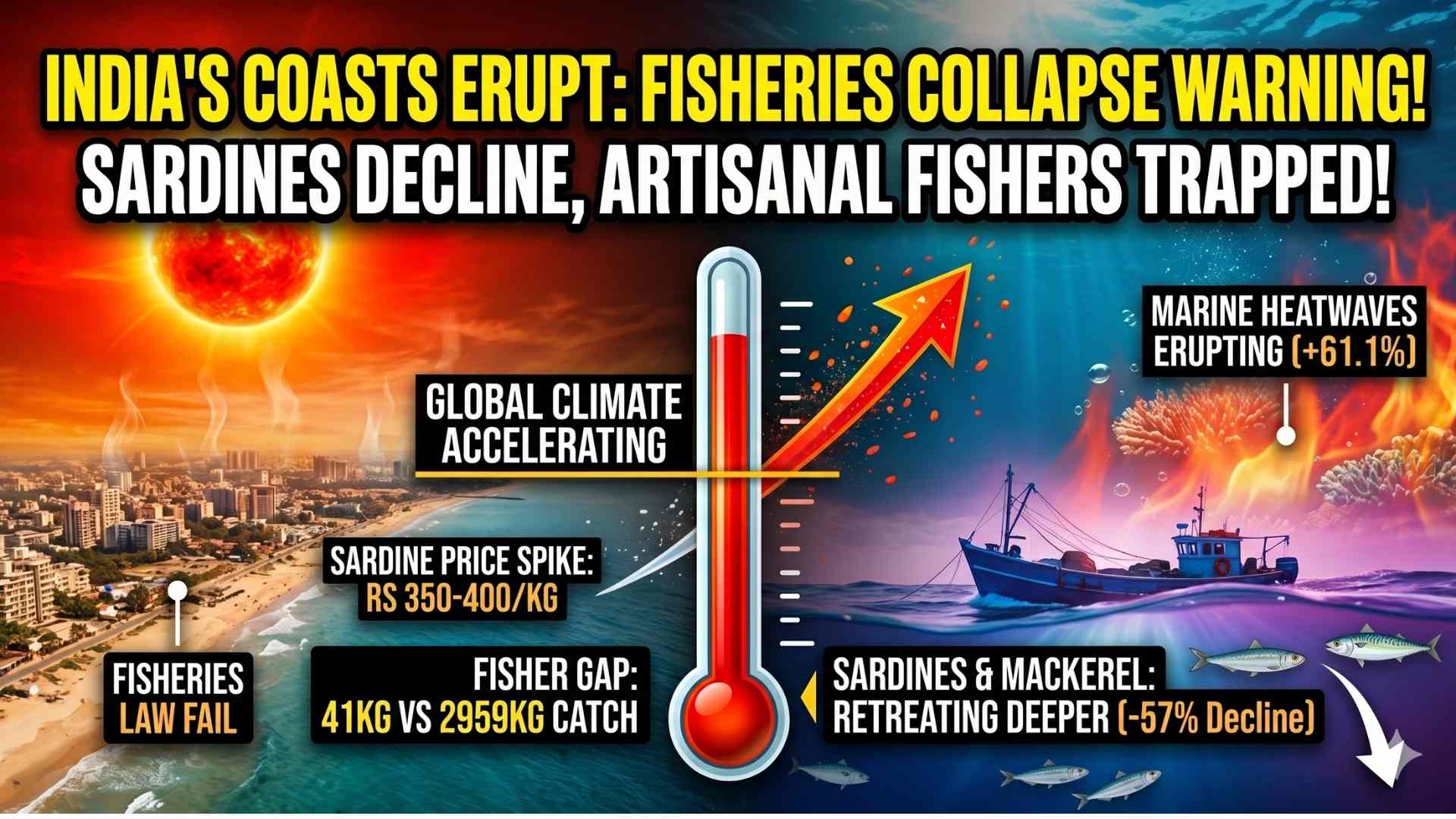
What is a marine heatwave (MHW) and how frequent are they?
Marine heatwaves (MHWs) are officially defined as periods when the sea surface temperature exceeds the 90th percentile of historical records for at least five consecutive days.
Driven by anthropogenic climate change, their frequency, duration, and intensity have skyrocketed globally over recent decades. A landmark 2025 study in Nature Climate Change revealed that the summers of 2023 and 2024 saw nearly 3.5 times as many MHW days as any previous year on record. During this period, roughly 10% of the global ocean surface hit record-high temperatures.
The threat is accelerating: As of May 2026, the Indian National Centre for Ocean Information Services (INCOIS) had issued MHW alerts across six Indian Ocean basins, with nearly 36% of the Arabian Sea experiencing varying degrees of heat stress.
Why are the waters around India warming so rapidly?
The Indian Ocean is currently one of the fastest-warming ocean basins on the planet. Research points to specific regional mechanisms amplifying this warming:
-
Weakened Wind Currents: A 2022 study in JGR Oceans by Saranya et al. (IITM Pune) found that a relaxation of cross-equatorial monsoon winds weakens the ocean currents that normally transport heat away from the equator, causing a localized amplifying effect. The study found MHWs increased up to fourfold in the tropical Indian Ocean between 1982 and 2018.
-
El Niño and La Niña: A 2026 study in Frontiers in Climate by Joseph et al. identified two dominant patterns: basin-wide MHWs in the Arabian Sea during El Niño years, and a dipole pattern with Bay of Bengal warming during La Niña years. Both patterns suppress monsoon winds.
Climate projections by IITM suggest the Indian Ocean could endure between 220 and 250 MHW days annually by 2050.
Where have the fish gone, and how does this affect marine ecology?
Temperature-sensitive, near-surface species like the Indian oil sardine (Sardinella longiceps) and mackerel are struggling to survive in coastal waters that now routinely exceed their thermal optimum of 27–28°C.
-
To find cooler waters, these fish stocks are being forced to migrate deeper and further north.
-
Consequently, Kerala’s sardine catch has plummeted by 57% over the past decade.
-
Habitats are also collapsing; a 2020 MHW event bleached 85% of the coral reefs in the Gulf of Mannar, wiping out crucial fish nursery ecosystems.
Who is bearing the economic brunt of this climate shift?
The fisheries sector employs over 30 million people in India, but the climate impact is disproportionately hurting the poorest demographics.
-
Artisanal Fishers: Because sardines and mackerel have moved deeper and further out, they are now beyond the operational range of non-motorised and small motorised boats. In 2024, the Central Marine Fisheries Research Institute (CMFRI) noted that non-motorised boats landed only 41 kg of fish per trip, compared to a massive 2,959 kg for mechanised craft.
-
Low-Income Consumers: Severe sardine scarcity in early 2024 pushed prices to Rs 350–400 per kilogram along Kerala's southern coast, pricing out low-income households that have historically relied on them for affordable animal protein.
-
Women in the Supply Chain: Women manage approximately 70% of all post-harvest fisheries activities in India, including processing, marketing, and retail. When catches become erratic, this cohort absorbs the first economic shock through reduced trade volumes, extreme price volatility, and lost daily income.
What is the current state of India's marine production?
On paper, aggregate numbers look promising, but they mask a dangerous ecological shift. According to CMFRI data from April 2026, total marine fish production in 2025 hit 35.7 lakh tonnes (a 3% increase over 2024), generating Rs 69,254 crore.
However, this rebound was heavily driven by a 44% surge in Karnataka and gains concentrated in species less sensitive to thermal stress, such as cephalopods, which hit decadal highs. Aggregate tonnage fails to reflect the steep, ongoing decline of the nutritionally vital, temperature-sensitive pelagic fish that form the backbone of coastal diets.
When will policy catch up, and how must it change?
The institutions governing India's fisheries were built for an ocean that no longer exists. Existing frameworks like the Marine Fisheries (Regulation and Management) Act (MFRA) were designed around predictable monsoon seasons, known spawning grounds, and stable species distributions.
Currently, the MFRA contains critical structural absences:
-
There are no temperature-linked stock advisories.
-
There is no mechanism for dynamic fishing zone adjustments tied to real-time sea surface temperature data.
-
There is no climate vulnerability classification for species in quota or licensing design.
Experts argue that if India’s blue economy vision is to be realized, climate resilience must become a non-negotiable pillar. Real-time INCOIS MHW data must be embedded into dynamic advisories, quotas must be redesigned for thermally driven stock displacement, and coral reef restoration must be treated as essential fisheries infrastructure rather than "conservation charity".