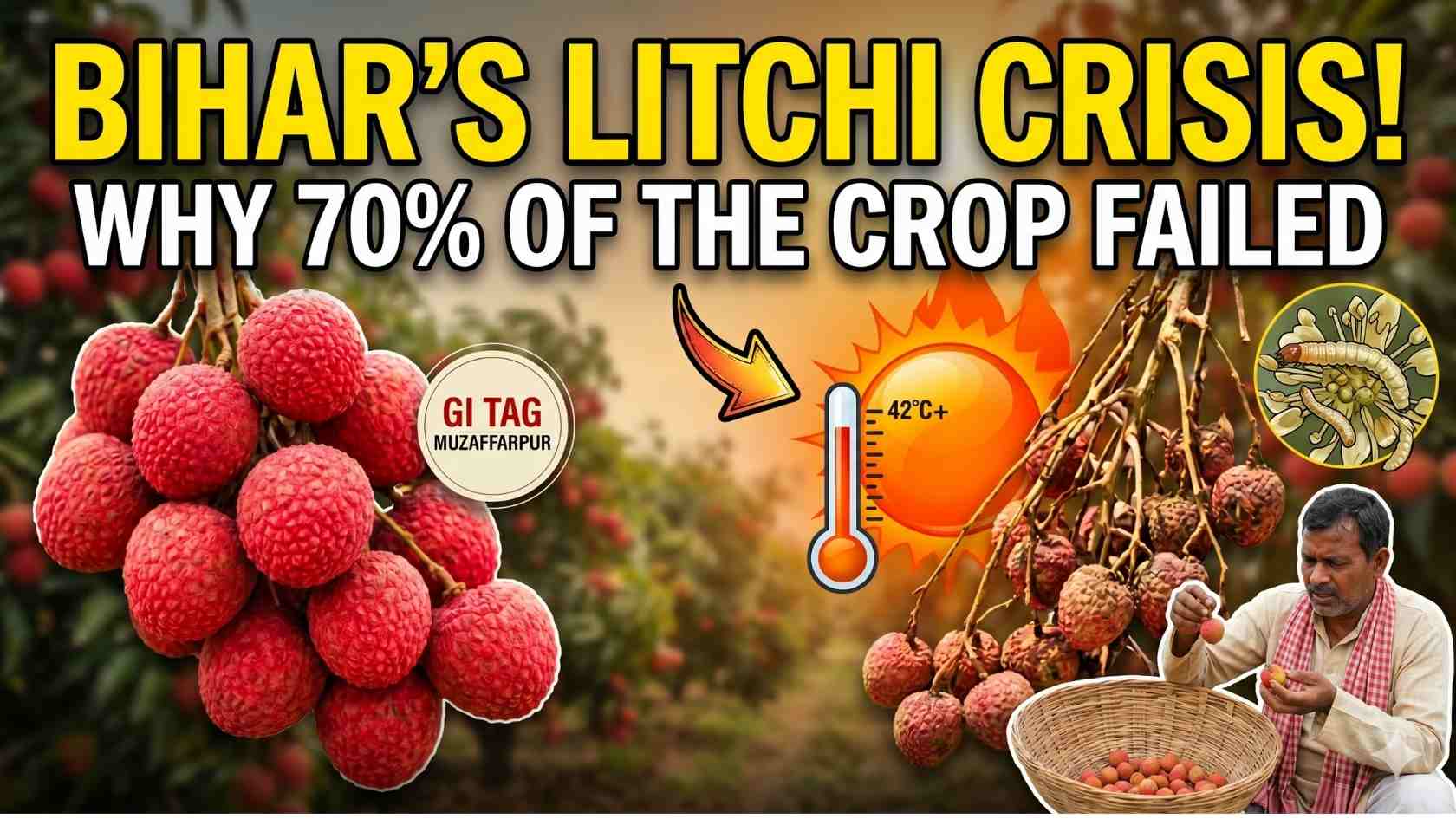
What is the Scale of the Crisis?
The 2026 litchi season has turned into a nightmare for farmers across Bihar's key producing districts. Orchards that would normally be heavy with clusters of deep pink and red fruit are sparse.
-
Farmers report harvests at barely 30 to 40 per cent of their usual volume.
-
In the worst-affected areas, a 40–50 acre orchard that would normally produce 25,000 boxes of litchis is yielding only 7,000–8,000 boxes this year.
-
The National Research Centre on Litchi (NRCL), headquartered in Muzaffarpur, confirmed these ground realities, estimating orchard yields at only 30–40 per cent of normal.
-
Bihar accounts for approximately 43 per cent of India's total litchi output, producing roughly 3 lakh metric tonnes across 32,000 hectares.
-
Muzaffarpur alone accounts for around 12,000 hectares of this cultivation area.
Year of "climatic abnormality," three separate weather events damaged the crop at critical life cycle stages.
Why Did This Happen? The Three Climate Failures
Litchi is one of India's most climate-sensitive commercial fruits. It requires a precise sequence of temperature, humidity, and rainfall. In 2025–26, every growth stage was disrupted:
Failure 1: Inadequate Winter Chill (November–December 2025) Litchi flower buds require a period of cold temperatures (typically below 15°C) during winter to differentiate properly.
-
According to 25 years of NRCL data, minimum temperatures in November 2025 were 1.8°C above the normal chilling baseline.
-
Temperatures remained 0.8°C above normal into mid-December.
-
Instead of producing flower buds, the warmer temperatures caused the trees to push out new vegetative leaves, severely reducing potential fruit count from the start.
Failure 2: Flower Webber Attack (February–March 2026) When the trees finally flowered, they faced prolonged cloudy weather and untimely rainfall, which created ideal breeding conditions for the flower webber pest (Conopomorpha sinensis).
-
This pest webs together young flowers and shoots, actively preventing pollination.
-
Fruit setting—the conversion of flowers into developing fruits—was severely impaired across large tracts of land.
Failure 3: Above-Normal April Temperatures and Fruit Drop For the fraction of fruits that successfully set, above-normal temperatures in April triggered premature fruit drop, as heat stress accelerates the shedding (abscission) of developing fruits.
-
Thunderstorms in April and May compounded the damage.
-
High-velocity winds physically stripped surviving litchi clusters from the trees across multiple districts.
Litchi Cultivation in India: How It Works
To understand the crop's vulnerability, one must look at its exacting requirements and how it is traditionally cultivated.
Agro-climatic Needs:
-
A cold, dry winter period (8–10°C to around 15°C) lasting 6–8 weeks is a non-negotiable requirement to induce flowering.
-
It thrives at altitudes of 100–800 metres above sea level with distinct dry winters and wet summers.
-
Ideal rainfall is 1,200–2,000 mm annually, but it must be completely absent during the February–March flowering phase.
-
It needs high humidity (above 70%) during fruit development, but dry weather during harvest to prevent the skins from cracking.
Planting and Maintenance:
-
Trees are propagated primarily through air-layering (gootee) to preserve traits, as growing from seed is unreliable.
-
Spacing is typically 8–10 metres (100–156 trees per hectare), planted in 90×90×90 cm pits enriched with organic matter and superphosphate.
-
Fertilisation requires NPK (Nitrogen, Phosphorus, Potassium) in a 100:50:100 gram ratio per year of tree age, split into post-harvest and pre-flowering doses.
-
Irrigation is essential before flowering (October) and during fruit development (February–May). However, irrigation must be strictly withheld during the 2–3 months of winter chill to prevent unwanted vegetative growth.
Key Indian Varieties:
-
Shahi: Grown in Muzaffarpur, Bihar (GI-tagged), known for its premium quality, rose-water aroma, and small seed.
-
China / Late Bedana: Grown in Bihar and UP, known as a seedless or near-seedless late-season variety.
-
Purbi: Grown in Bihar and West Bengal, characterized as an early-bearing, medium-sized fruit.
-
Calcuttia: Widely grown in West Bengal, known for its large fruit.
-
Rose Scented: Suited to the hill slopes of Uttarakhand and Himachal, noted for its strong aroma.
-
Dehradun: Grown in Uttarakhand, valued for its large fruit and good shelf life.
-
Bombai: Grown in West Bengal, favoured as a high-yield commercial variety.
Pests, Harvest, and Post-Harvest:
-
The Flower Webber is the most damaging pest, managed with imidacloprid or chlorpyrifos sprays. The Litchi Sting Bug (Tessaratoma javanica) is managed with carbaryl or neem sprays, and fungal diseases with copper oxychloride or mancozeb.
-
Litchis are harvested with a small branch attached (panicle harvesting) to improve appearance and shelf life.
-
Shelf life is a critical hurdle: the skin browns within 24–48 hours at ambient temperatures.
-
Because cold chain infrastructure is underdeveloped, most fruits travel in non-refrigerated trucks, arriving bruised. This has sometimes led to the illegal and hazardous use of sulphur fumigation to artificially extend shelf life.
The Shahi Litchi: Bihar’s GI Pride
The Shahi litchi of Muzaffarpur is to Bihar what the Alphonso mango is to Ratnagiri. It was awarded a Geographical Indication (GI) tag in 2018, certifying that only litchis grown in a defined zone of Muzaffarpur can carry the name. It is prized for its distinct rose-water aroma, exceptionally sweet and translucent juicy pulp, and a disproportionately small seed.
A collapse in this production does not merely affect local farmers; it creates a ripple effect through the national supply chain, raising consumer prices and depriving export markets of a premium Indian horticultural product.
Is Climate Change the New Normal?
Scientists caution against confusing a single bad year with a systemic trend, but evidence suggests the baseline is shifting. Dr. Abdus Sattar of the Centre for Advanced Studies on Climate Change noted that litchi has repeatedly faced climate-linked stresses in recent years, suffering deeply from high winds and thunderstorms causing severe fruit drop.
The central issue is a misalignment between the litchi's biological requirements and Bihar's changing climate profile: winters are becoming shorter and warmer, while pre-monsoon weather is increasingly erratic with unseasonal rains. Mohammad Feza Ahmad, a horticulture scientist at Bihar Agricultural University, added that these climate variations degrade the fruit's sugar assimilation, resulting in smaller, less sweet, and less aromatic litchis even when the crop survives.
What Needs to Change?
The 2026 crisis highlights major structural vulnerabilities. Interventions currently being discussed include:
-
Micro-climate mapping: Identifying pockets in Bihar with stable winter chilling regimes to protect crops from temperature volatility.
-
Improved pest forecasting: Integrating weather data with pest models to issue early warnings for flower webber attacks.
-
Irrigation scheduling: Training farmers to withhold water during October–November to allow proper bud differentiation.
-
Cold chain investment: Expanding pre-cooling, wax coating, and refrigerated transport to reduce post-harvest losses and protect farmer incomes.
-
Crop insurance access: Expanding the Pradhan Mantri Fasal Bima Yojana (PMFBY) to better cover horticulture losses.
-
Variety diversification: Developing and promoting heat-tolerant litchi varieties that can maintain yields under rising temperatures.
The Bottom Line Bihar’s litchi farmers have lost a season, but the true significance of 2026 is how ordinary these compounding extreme weather events are beginning to feel. A warming winter, an untimely storm, and an early heatwave combined to wipe out the crop. As beloved summer fruits like mango, litchi, and jackfruit become testing grounds for climate adaptation, the question is no longer if disruptions will happen, but whether the necessary institutions, infrastructure, and scientific capacity exist to buffer farmers against them.