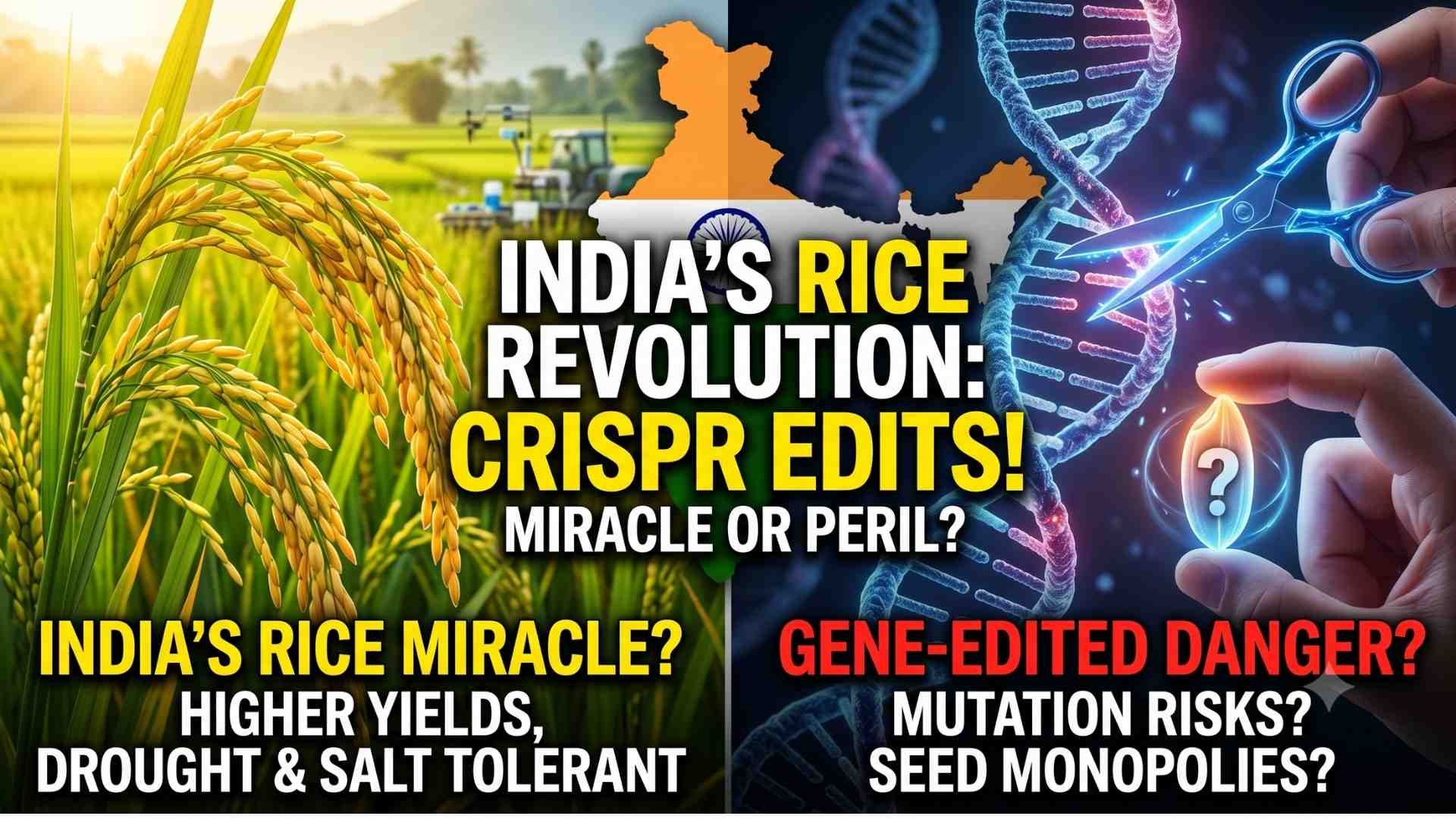
With the launch of two revolutionary rice varieties—DRR Dhan 100 (Kamala) and Pusa DST Rice 1—India is taking a massive leap into the future of agriculture using cutting-edge CRISPR-Cas9 technology. While the government views this as a silver bullet for climate resilience and sustainable farming, the move has sparked intense debate. Scientists and activists are warning of potential risks, from unintended genetic mutations to corporate monopolies over seeds. Here is a breakdown of the science, the promises, and the pushback.
The New ‘Climate-Smart’ Varieties
In May 2025, the Indian Council of Agricultural Research (ICAR) marked a historic milestone by unveiling the nation's first genome-edited rice varieties. These seeds are engineered improvements of massively popular traditional rice strains, edited for specific climate-resilient traits without introducing foreign DNA.
-
DRR Dhan 100 (Kamala): Developed by the ICAR-Indian Institute of Rice Research (IIRR) in Hyderabad, this variety is an improved version of the widely favored Samba Mahsuri rice. Scientists targeted a specific gene to enhance grain count. Remarkably, this variety matures about 20 days earlier than its parent strain. This accelerated growth drastically reduces its water and fertilizer needs, lowers methane emissions from paddy fields, and still delivers up to a 25% increase in yield.
-
Pusa DST Rice 1: Developed by the ICAR-Indian Agricultural Research Institute (IARI) in New Delhi, this is an upgraded version of the MTU 1010 cultivar. By targeting the DST (Drought and Salt Tolerance) gene, researchers created a variety that thrives in challenging environments. It promises up to a 30% yield boost in coastal and inland saline soils, areas where traditional rice struggles to survive.
The Science: How CRISPR-Cas Works
In nature, CRISPR is a built-in defense mechanism found in bacteria to protect them against invading viruses. When a virus attacks, the bacteria capture small pieces of the viral DNA. If the same virus attacks again, the bacteria deploy an enzyme called Cas9—acting as "molecular scissors"—to cut and neutralize the viral DNA.
Scientists have adapted this system for agriculture. By creating a synthetic "guide RNA," they direct the Cas9 enzyme to a precise location in the plant's genome. The enzyme cuts the DNA, and the plant's natural repair mechanism fixes it. This allows scientists to slightly alter the genetic code to enhance beneficial traits or suppress weaknesses.
Key insight: CRISPR operates much like a modern word processor. It finds a specific "typo" in the DNA manuscript and edits it directly, rather than pasting in whole paragraphs from an entirely different book.
The Difference: Gene Editing vs. Genetically Modified Organisms (GMOs)
To understand why these new rice varieties were approved so quickly, it is crucial to understand the scientific and legal differences between CRISPR gene-editing and traditional Genetically Modified Organisms (GMOs).
The distinction essentially comes down to the origin of the genetic material being manipulated. Traditional GMOs—like Bt Cotton or Golden Rice—are created using a process known as transgenesis. This involves taking a foreign gene from an entirely different species (such as a soil bacterium) and inserting it into the plant's genome to give it a new trait, like pest resistance. Because this introduces foreign DNA that would never naturally occur in the plant, GMOs are subjected to decades of stringent biosafety trials to ensure they do not harm human health or the environment.
CRISPR gene editing, specifically the Site-Directed Nuclease (SDN-1 and SDN-2) techniques used by Indian scientists, works entirely differently. It does not introduce any foreign DNA into the rice. Instead, it simply tweaks the plant's existing genetic code, speeding up natural mutations that could theoretically occur over centuries of traditional cross-breeding. Because the final plant contains no foreign genes, the Indian government has classified these crops under a simplified New Breeding Technologies (NBT) framework. This legally exempts them from the rigorous, long-term testing required for traditional GMOs, allowing them to move from the laboratory to the farm at an unprecedented speed.
The Big Promises
For the government and agricultural scientists, the rapid adoption of these varieties is viewed as a critical lifeline for national food security in the face of climate change.
-
Massive Resource Savings: Because Kamala rice matures 20 days earlier, early estimates suggest scaling this crop could save up to 7,500 million cubic meters of irrigation water annually.
-
Emissions Reductions: Paddy cultivation is a major source of agricultural methane. By shortening the growth cycle and requiring less standing water, these genome-edited varieties are projected to reduce greenhouse gas emissions by roughly 20%.
-
Reclaiming Wasteland: Pusa DST Rice 1's profound tolerance to salinity means millions of hectares of degraded coastal and alkaline land can become highly productive again, boosting farmer incomes in historically difficult regions.
The Pushback: Why the Concern?
Despite the optimistic projections, the launch has faced staunch opposition from civil society groups, environmental activists, and agricultural economists. Their concerns fall into three primary categories:
-
Unintended Mutations and Biosafety: While CRISPR is highly precise, "off-target" effects can occur, where the Cas9 enzyme cuts DNA at unintended locations. Activists argue that bypassing the strict, long-term biosafety trials required for GMOs means we lack comprehensive, independent data on the long-term environmental and health impacts of these specific edits.
-
Monopolies and Seed Sovereignty: The core technology of gene editing—the CRISPR-Cas system—is heavily patented and largely controlled by Western multinational corporations. Critics warn that relying on patented biotechnologies could eventually lead to corporate monopolies over seeds, driving up costs for smallholder farmers and threatening India's traditional seed-saving practices.
-
Threats to Biodiversity: There are profound fears that flooding the market with heavily engineered, highly successful mega-varieties will further erode the genetic diversity of India's indigenous rice strains. A monoculture of genetically similar crops makes the overall agricultural ecosystem much more vulnerable to novel pests and diseases in the long run.